

The Manila Water enterprise continues to lead the way in sustainable energy adoption as it transitions fifty-six (56) additional facilities to the Energy Regulatory Commission’s Retail Aggregation Program (RAP).
As it transfers fifty-six (56) more facilities to the Energy Regulatory Commission’s Retail Aggregation Program (RAP), Manila Water Enterprise remains in the forefront of the use of sustainable energy.
The 56 facilities include the Manila Water Foundation’s La Mesa Ecopark, the first and largest ecopark to be powered entirely by renewable energy under RAP, 10 additional facilities from Manila Water Non-East Zone operating unit Laguna Water, and 45 Estate Water facilities serving Bulacan, Cavite, Laguna, and Metro Manila. These facilities further demonstrate the dedication to sustainable operations and cutting-edge energy solutions. 1,682 kW is the total demand associated with the transition.
This milestone was marked with another RAP switching ceremony held at the La Mesa Ecopark in Quezon City, which is the 4th switching for Manila Water this year.
“Manila Water’s participation in RAP demonstrates its commitment to innovation and consumer empowerment. By aggregating demand and leveraging competitive supply options, Manila Water is helping pave the way for a more inclusive and resilient energy sector. At the ERC, our mandate is clear: to promote consumer welfare while ensuring a fair and competitive energy market and RAP is a key component of this vision.” said ERC Director for Market Operations Service Sharon Montaner.
“Since Manila Water’s first switching in February 2025, RAP participation has grown by 70%, a rate faster than RCOA, reflecting greater inclusivity and freedom of choice”, Director Montaner further noted.
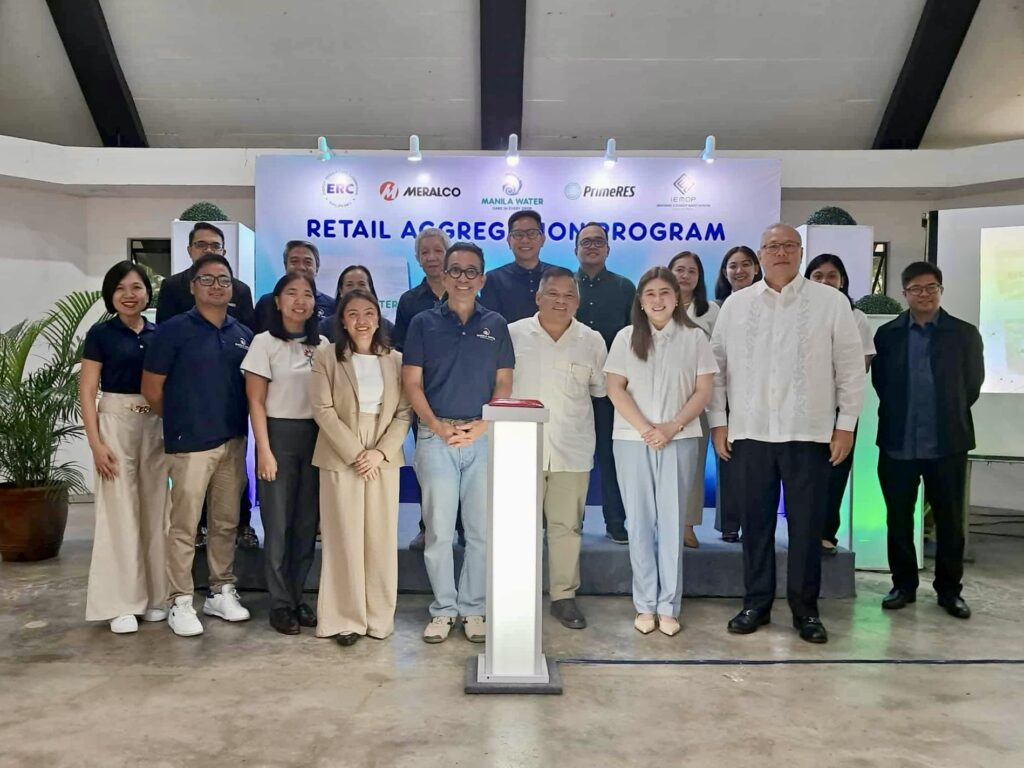
The 56 facilities consist of 10 additional facilities from Manila Water Non-East Zone operating unit Laguna Water, 45 facilities of Estate Water covering Bulacan, Cavite, Laguna and Metro Manila, and Manila Water Foundation’s La Mesa Ecopark.
The event was also graced by ERC Chair Francis Saturnino Juan, MWSS Corporate Office Department Manager for Policy, Planning, and Public Relations Christian Nicole Baluca, MWSS-RO Legal Affairs Department Manager Crescenciano Minas Jr., PrimElectric Holdings Chief Operating Officer Richard Nethercott, IEMOP Vice President for Administration Sheryll Dy, MERALCO AVP and Head of Enterprise Commercial and Conglomerates Bernice Rama and representatives from the Climate Change and Sustainability Department of the Quezon City Local Government.
With these developments, Manila Water now sources electricity for a total of 214 facilities, representing an aggregated demand of 11 MW. Under the enhanced RAP framework, these facilities are supplied by PrimeRES Energy through Meralco’s distribution network.
“This is all about the power of choice. We have 214 facilities switched now to RAP… and that’s very powerful because at the end of the day, we are held as a utility accountable to the costs that we charge our customers. We’ve tried to rethink our approach towards tariff and our customer base and really be as sufficient as possible,” says Jocot De Dios, Manila Water President and CEO.
Earlier this year, Manila Water pioneered the country’s first transition to the enhanced Retail Aggregation Program, consolidating ten (10) of its wastewater facilities under a single electricity sourcing. This marked a significant step in leveraging the RAP framework to streamline energy procurement and reduce costs.
Building on this momentum, the Company expanded its aggregation efforts through its operating units. In April, Laguna Aquatech facilitated the switch of 25 facilities, representing a combined demand of 900 kW. Additionally, Laguna Water transitioned 67 more facilities, contributing a substantial 4.3 MW to the total aggregated demand.
As the first utility in the Visayas to use RAP, Boracay Water made history in May. Its switch featured 11 facilities, from pumping stations and water treatment plants to lift stations and wastewater treatment facilities, underscoring RAP’s versatility in a variety of operational configurations.
Customers like Manila Water can now combine the electrical needs of their facilities that are situated within the same distribution utility franchise zones under the improved Retail Aggregation Program (RAP) framework. One of the main goals of the EPIRA is to increase the affordability of energy options in the retail electricity market, and this strategy supports the idea of customer choice.

No Comments